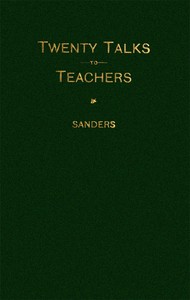
Twenty Talks to Teachers — Edition Insights
Edition facts
Before opening Twenty Talks to Teachers — Edition Insights, the edition data offers a quick orientation: 53,339 words, 3 hr 52 min estimated reading time, and 25 detected text sections.
The text analysis averages about 18.0 words per sentence, while the detected sections provide another way to judge how the source is divided.
Project Gutenberg metadata also associates the work with “Teaching,” connecting these edition facts with the source record’s subject description.
Calculated from edition completeness, EPUB availability, text structure and catalogue metadata. Not a user rating.
How this score is calculated
- Description quality20 pts
- Title & short description10 pts
- Source metadata20 pts
- Text length15 pts
- Chapters / structure15 pts
- EPUB file integrity20 pts
Total of 100 points, scaled to a 2.5-5.0 range. Editions with an empty description or a missing EPUB file are not scored.
Read the Text
CHAPTER II. SHALL TEACHING BE MY LIFE WORK? 14
CHAPTER III. SECURING A POSITION 21
CHAPTER IV. PASSING THE EXAMINATION 31
CHAPTER V. PROBLEMS OF THE YOUNG TEACHER 36
CHAPTER VI. GRADING A SCHOOL 44
CHAPTER VII. OPENING EXERCISES 55
CHAPTER VIII. THE SPIRIT OF THE TEACHER 63
CHAPTER IX. THE TEACHER’S LIBRARY 70
CHAPTER X. THE TEACHER OUTSIDE THE SCHOOLROOM 80
CHAPTER XI. GOOD TEACHING CONDITIONS 90
CHAPTER XII. KEEPING GOOD CONDITIONS 96
CHAPTER XIII. WHAT MAKES A GOOD SCHOOL? 105
CHAPTER XIV. TEN TIME KILLERS 116
CHAPTER XV. THE VALUE OF A HIGH SCHOOL COURSE 125
CHAPTER XVI. A TALK ABOUT SPELLING 132
CHAPTER XVII. ARITHMETIC IN THE SCHOOL 142
CHAPTER XVIII. TEACHING LITERATURE 153
CHAPTER XIX. THE TEACHER’S VACATION 166
CHAPTER XX. THE TEACHER’S VIEW OF LIFE 172
The talks that follow are addressed to young teachers. They treat everyday problems in a homely way. I have tried to be plain and pointed. I have omitted long terms. I do not speak of correlation, apperception, spontaneity, etc., and I omit long psychological terms. You get enough of these in county institutes and educational journals.
You are a school teacher. You have taught but a short time, and you want to make a success of the work. You may not be even a professional teacher. You hold neither a normal school diploma nor a life license. Both of these are good, and a desire for one or both upon your part would be commendable, but neither is all that is required to teach a successful school. Some of the most impractical of visionary dreamers I have ever known possessed the first, and the most tiresome of moss-backs the second. Given a young man or a young woman of good character and fair scholarship, desiring to teach school, with little or no professional study or training, yet anxious to succeed, what may I say to help them? What are the problems which they must face? What advice and what cautions will they need, and how may I say this to be most effective? This is my task.
Perhaps a little self-catechising on your part will be helpful. In the daily hour of self-communion--and each teacher should have such an hour--when you turn your thoughts inward and analyse your own motives and shortcomings, ask yourself in all seriousness: “Am I fit to teach?” You may not be a “born teacher.” Very few persons are. Few indeed have the inborn qualities so strong that teaching and teaching alone will satisfy. Few are so heavenly inspired that they may teach and succeed at it in defiance of all rules or regulations or accepted laws of pedagogy. There are some qualities that will help you and some qualities that you may cultivate--qualities that are essential to the person who would aspire to be leaders and models for young people. What are some of these?
_1. Your character must be above reproach._--Whatever else you may lack, your character must be above suspicion. Character, unquestioned and unquestionable, first. Other things may be essential, but this is the one first essential. If you are to be the model after which the boys and the girls--the most priceless product of the state--will both consciously and unconsciously fashion their lives, you must be in all things a worthy model. Pure thoughts, pure words, sincerity, honesty, earnest and deep convictions must be habitual with you. The purity of your own thought, the sincerity of your own motives, flashing through your eyes, the windows of your soul, must call out and strengthen the purity and nobility of other minds. Your character and your reputation, too, must stand the search light of the X-ray without showing flaw or blemish. This, and this alone, is the character and reputation worthy the teacher, the builder and architect of immortal minds.
Character is what you are; reputation is what others think you are. Character is essential to pure manhood and pure womanhood, but reputation also is essential to the teacher. Reputation cannot exist long without character, but if from any cause however unjust your reputation is lost even though character remain, your best usefulness in that immediate community is gone. Then guard well your life if you are to teach. Avoid not only evil but the appearance of it. Be not prudish, but keep your reputation unsullied or seek not to stand as teacher to the young.
Thomas E. Sanders opens Twenty Talks to Teachers with a direct question—"Am I Fit to Teach?"—and sustains that practical, self-examining tone across twenty chapters. The book is structured as a series of institute lectures, each addressing a concrete problem: passing examinations, grading a school, managing time, or choosing a library. Sanders writes in short, declarative sentences and frequently addresses the reader as "you," creating the sense of a seasoned colleague offering counsel rather than a theorist delivering a treatise.
The chapters move from preparation (securing a position, passing exams) through the daily work of teaching (opening exercises, maintaining order) to broader professional concerns (the teacher's vacation, view of life). This sequence mirrors the arc of a teaching career, though the excerpts show that Sanders returns repeatedly to a few core ideas: the importance of self-discipline, the need for genuine interest in pupils, and the value of a hearty laugh as a classroom tool.
A Career Measured in Years
Sanders notes in his preface that the average teacher serves "little over three years," a statistic that shapes the book's entire approach. He is writing for beginners, not veterans, and he assumes his readers will face problems of inexperience: how to control a room, how to grade mixed ages, how to recover from a poor start. The chapters are short—each could be delivered in a single institute session—and they avoid abstract pedagogy in favor of actionable advice. Sanders does not claim profundity; he aims to be "suggestive" and to help young teachers "over a few of the hard places." This modesty is consistent throughout the excerpts, where he often hedges his recommendations with phrases like "perhaps" and "if the advice proves sound."
Order as Intelligent Quietness
In the chapter on keeping good conditions, Sanders defines good order not as mere silence but as "intelligent quietness." He distinguishes between internal and external motives for behavior, urging teachers to appeal to the former while being ready to use the latter. A telling passage asks whether a teacher can leave the room for ten minutes and return to find "things moving on with proper decorum." Sanders insists the best teachers can, and he recounts a class that became entirely trustworthy in two weeks under a new teacher. The fault, he implies, lies with the teacher who fails to establish a positive force. He also offers a practical criterion for rules: any conduct that destroys the unity of mind between teacher and class should be forbidden.
The Holiday Spirit and Lost Time
Sanders is acutely aware of the calendar's effect on schoolwork. In one excerpt he warns that as Christmas approaches, "school interest must not begin to drag, or else the holiday spirit will overbalance school spirit." He notes that lost time is "hard to recover" and lost interest at mid-term is "seldom completely restored." This attention to the rhythms of the school year—the first day, the holiday slump, the end of term—gives the book a practical, seasonal structure. Sanders advises that it is "far easier to form than to reform," urging teachers to establish definite standards from the start. His advice is grounded in the assumption that a school term is a finite, fragile period that can be derailed by a single bad week.
A Library of One's Own
Chapter IX, "The Teacher's Library," signals Sanders's belief that professional growth depends on reading. He does not prescribe a specific list in the excerpts, but the chapter's placement—after discussions of spirit and before the teacher's life outside school—suggests that he sees books as a bridge between personal development and classroom practice. Sanders himself wrote multiple educational manuals, and his style in Twenty Talks reflects a writer who values clarity over ornament. He avoids jargon, uses short paragraphs, and often breaks advice into numbered points. The book's structure, with twenty self-contained talks, makes it easy to dip into; a teacher could read one chapter before bed and apply its ideas the next morning.
Twenty Talks to Teachers is best read not as a systematic treatise but as a series of conversations with an experienced superintendent. Sanders does not pretend to cover every topic; he leaves many questions open, trusting the reader to adapt his suggestions to local conditions. The book's value lies in its specificity—the concrete cautions about holiday distractions, the criteria for good order, the frank discussion of teacher turnover. For a modern reader, it offers a window into the daily concerns of early twentieth-century American schooling, when a teacher's success could hinge on knowing how to handle a whispering student or when to laugh.
Sometimes, when I hold the plain-spoken 1908 talks to young teachers, I think of the other volume on my shelf, Dorothea Beale: Principal of the Cheltenham Ladies' College, 1858-1906 — Story, Setting & Ideas. One whispers practical common sense; the other, a quiet, stubborn vision for women’s minds. They never met, yet share a gentle, unspoken respect for the daily patience of a good classroom.

There are no reviews for this eBook.
How did this book work for you?
Your answers remain private and are stored only in this browser.