About 310 minutes
Education and life — Key Ideas to Explore
Teaching Methods
71,223 recorded words. 0 minutes difference from this book's estimate.
View Gutenberg source #72291
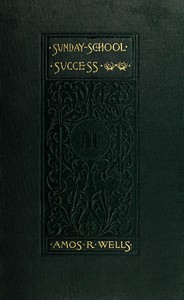
Before opening Sunday-School Success A Book of Practical Methods for Sunday-School Teachers and Officers — Text and Context, the edition data offers a quick orientation: 71,280 words, 5 hr 10 min estimated reading time, and 7 detected text sections.
The text analysis averages about 18.7 words per sentence, while the detected sections provide another way to judge how the source is divided.
Project Gutenberg metadata also associates the work with “Sunday schools,” connecting these edition facts with the source record’s subject description.
Explore this collection
These alternatives are selected using recorded categories and estimated reading time.
About 310 minutes
Teaching Methods
71,223 recorded words. 0 minutes difference from this book's estimate.
View Gutenberg source #72291About 302 minutes
Teaching Methods
69,378 recorded words. 8 minutes difference from this book's estimate.
View Gutenberg source #38180About 302 minutes
Teaching Methods
69,238 recorded words. 8 minutes difference from this book's estimate.
View Gutenberg source #61045Search stored excerpts and compare books → Choose by your preferences →
Choices use stored catalog measurements. Estimates vary with reading speed. A shared category is a catalog label, not a claim that two books have the same argument or literary quality.
Search reads excerpt text stored with this catalog and links to its associated Gutenberg record. The connection is stored in the site database; this tool does not recheck that every excerpt is word-for-word identical to that external record. Excerpt search does not cover every chapter and does not verify historical publication dates.
Catalog snapshot checked: 2026-09-25. Coverage: 96 public books, 96 available source excerpts.
Calculated from edition completeness, EPUB availability, text structure and catalogue metadata. Not a user rating.
Total of 100 points, scaled to a 2.5-5.0 range. Editions with an empty description or a missing EPUB file are not scored.
Public-domain source text
The source text is kept in the dedicated reader, separate from this catalogue record and its commentary.
Amos R. Wells opens his 1897 manual with a frank admission: the book sets forth what he learned from his failures rather than his successes. This humility shapes the entire work, which offers concrete, experience-based advice rather than abstract theory. Wells, who taught in district schools, small colleges, and Sunday schools, addresses the practical problems of an average teacher. The chapters, many previously published in periodicals like the Sunday-school Times and the Baptist Teacher, cover lesson preparation, questioning techniques, blackboard use, and class organization. Wells emphasizes that a teacher plus a bit of chalk is two teachers, and he advocates for colored crayons and simple diagrams to capture attention.
Wells repeatedly grounds his advice in his own classroom struggles. He describes himself as an average teacher who never had charge of a large school or class, yet found ways to succeed. This perspective gives the book a down-to-earth tone. For instance, he recounts how a lecturer gained instant attention by simply touching a piece of chalk to a blackboard, doing nothing else. Wells uses this anecdote to argue that a teacher with a bit of chalk is effectively two teachers. He recommends flexible blackboards, slates, or even manilla paper tacked to boards, and stresses that artistic skill is less important than trusting children's active imaginations. He notes that in children's own drawings, straight lines stand for men and circles with three dots represent faces.
Wells devotes a chapter to class organization, advising teachers to elect officers every six months and rotate them thoroughly. He insists that genuine responsibility must be placed on officers: the teacher should give up the front of the class to the president during business, wait to be recognized before speaking, and make few motions. To foster loyalty to substitute teachers, Wells suggests having the class elect a substitute and an alternate when the teacher is absent. However, he warns that the plan fails if the teacher delegates entirely; the teacher must also invite strangers and seek new members. He uses a striking metaphor: the teacher alone has the dipper of water that starts the pump. An ounce drawn out from scholars is better than a ton put in.
Several chapters focus on maintaining attention and effective questioning. Wells discusses getting and keeping attention, the importance of questioning, and what makes a good question. He introduces terms like trigger-teaching, galvanic teaching, and serial teaching, suggesting methods to provoke student response. In the chapter on questioning, he likely emphasizes clear, thought-provoking queries. He also addresses the problem of late scholars and how to utilize them, and warns against side-tracking the teacher. Wells's language is direct and metaphorical: he speaks of righteous padding, the trial balance, and the teacher's three graces. These chapters reveal a teacher constantly experimenting with techniques to engage his class.
Wells tackles specific Sunday-school problems with practical solutions. He discusses teaching the Psalms, temperance and missionary lessons, and topical lessons. He advises on introducing thoughts, illustrations and applications, and using the Sunday school and newspaper. He warns against taking things for granted and addresses the problem of visitors. One chapter is titled Under Petticoat Government, likely dealing with the predominance of female teachers. He also covers the superintendent's role, the Sunday school and the weather, and how to run a profitable picnic. Throughout, Wells draws on his own experience and that of successful teachers he knew, offering concrete, actionable advice rather than general principles.
Wells's manual is best read as a collection of essays to be dipped into rather than read straight through. Each chapter stands alone, addressing a specific problem with a clear, practical solution. Readers will find the most value by selecting chapters that match their current challenges, whether that be lesson preparation, maintaining attention, or organizing a class. Wells's frankness about his own failures makes his advice trustworthy and his methods easy to adapt.
I keep returning to the old Sunday-school room—dust on the chalk tray, the quiet rustle of a turned page—and that 1897 manual showed up like a faint photograph. It made me stop and remember how another book, The Philosophy of Teaching The Teacher, The Pupil, The School — Inside the Classic, once felt less like instructions and more like a patient hand on my shoulder.
Save your reaction, strongest insight, and memorable passage.