The Early Irish Monastic Schools A study of Ireland's contribution to early medieval culture — Text and Context
Edition facts
The source record for The Early Irish Monastic Schools A study of Ireland's contribution to early medieval culture — Text and Context measures this digital text at 51,186 words, 3 hr 43 min estimated reading time, and 16 detected text sections.
The text analysis averages about 15.5 words per sentence, while the detected sections provide another way to judge how the source is divided.
Project Gutenberg metadata also associates the work with “Education, Medieval,” connecting these edition facts with the source record’s subject description.
Calculated from edition completeness, EPUB availability, text structure and catalogue metadata. Not a user rating.
How this score is calculated
- Description quality20 pts
- Title & short description10 pts
- Source metadata20 pts
- Text length15 pts
- Chapters / structure15 pts
- EPUB file integrity20 pts
Total of 100 points, scaled to a 2.5-5.0 range. Editions with an empty description or a missing EPUB file are not scored.
Read the Text
g of wisdom, piety to God, ecclesiastical duty, relics, and protection.]
In the source book the following stanza is printed in an older Irish orthography and typeface, no longer in common use. Here it is printed using modern Irish orthography.]
Tuilleadh Feasa ar Éirinn óigh Do chruinnigheasa ó scoith-seanóir; Beag mo stuaim, gidh mór mo ghrádh Ar an oileán uasal, Eire áin. An t-Ughdar.
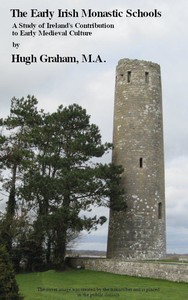
THE EARLY IRISH MONASTIC SCHOOLS
CIVILIZATION AND LEARNING IN IRELAND IN PAGAN TIMES
The precise state of civilization and learning in Ireland in pre-Christian times is difficult to determine owing to the fact that there is no native contemporary evidence of a documentary nature, while the references in the works of foreign writers are few in number and generally vague in character. Fortunately, however, there are a few sources of information which have been made available by the laborious and scholarly researches of generations of investigators. The principal of these sources are:
1. Archæology. 2. The so-called Brehon Laws. 3. Early Irish Literature. 4. Foreign Testimony. 5. Ogam Inscriptions.
A brief survey of the evidence supplied by each of these may be helpful in determining the nature and extent of Irish pagan culture.
ARCHÆOLOGICAL EVIDENCE:
Archæological research shows that Ireland was inhabited from very early times though it is impossible to fix the exact chronological limit of the earliest colonization. Passing over the beginnings of civilization which are exemplified by the crude implements and other remains of the Stone Age, we note that in the Bronze Age when the art of working metals had been discovered the existing specimens of the work of these ancient craftsmen point to a relatively advanced stage of civilization. Indeed, an examination of the discoveries of this period amply justifies the statement that “in point of wealth, artistic feeling and workmanship, the Irish craftsmen of the Bronze Age surpassed those of Britain.”[1] The doyen of prehistoric chronology, Dr. Oscar Montelius of Stockholm, having studied the antiquities of the British Isles, gave the result of his labours in a memoir published in 1918.[2] This work is now the standard authority on this subject. Dr. Montelius divides the Bronze Age into five periods. In the first period he includes the Transitional Period where copper was in use (Copper period) which he places between the middle of the third and the beginning of the second millenium, B.C. One of the greatest living Irish archæologists, Mr. George Coffey, while agreeing with the Scandinavian as to the division into five periods, would not place the first period so early as has been suggested by Dr. Montelius, but agrees that the first period ended between 2000 B.C. and 1800 B.C. Both writers would place the end of the fifth period, that is, the end of the Bronze Age about 350 B.C. Thus we may consider the Irish Bronze Age as extending approximately from 2000 B.C. to 350 B.C. Mr. Coffey in one of his valuable works gives numerous illustrations representative of each period.[3] The originals are nearly all in the National Museum, Dublin, where Mr. Coffey is the official Keeper of Irish Antiquities. A notable feature of the finds of this period is the abundance and variety of the gold ornaments. The collection of gold ornaments of Irish workmanship is the largest in the British Isles being twelve or thirteen times more than that in the British Museum.[4] Possibly, this is but a small fraction of the entire output of the Irish artists of pagan times; for many Irish gold ornaments have been discovered in Scandinavia and in Western Europe not to speak of many finds which never enter a museum.[5]
From such material remains it would appear to be a legitimate deduction that even at this early age the Irish were skilled craftsmen and acquired by some means at least an elementary and industrial and technical education and that they were already cultivating the æsthetic. Art was developing on distinctly national lines, yet the country was not isolated. There must have been direct communication with the Continent; for Mr. Coffey has traced Aegean and Scandinavian influence in the incised ornament of the New Grange group[6] and Iberian influence on some of the later type of bronze ornaments.[7]
Hugh Graham opens his study by positioning Irish monastic schools as a missing chapter in the history of Western education. He contends that standard narratives leap from the fall of Rome to the Renaissance, ignoring the continuity preserved in Ireland. The book’s structure moves from institutional origins to curriculum details, then to influence abroad, building a cumulative case for Ireland’s role in transmitting classical and Christian learning.
A Curriculum Broader Than Theology
Graham insists that the Irish monastic curriculum was not limited to Scripture and psalm-singing. He lists geography, computation, astronomy, philosophy, dialectic, church music, and art—including manuscript illumination, metalwork, and stone-carving. The native Irish language and literature were also studied. He argues that Christianity in Ireland did not displace native culture but fused with it, producing a distinct educational tradition. The study of pagan classics, he claims, was pursued without the scruples that troubled continental monks, because Irish monks viewed Greek and Roman myths as literary, not religious, threats.
Evidence from Manuscripts and Scribes
Graham draws on specific artifacts to support his claims. He cites the Carmen Paschale of Sedulius, a fifth-century Irish poet, as “the first Christian epic worthy of the name.” The Book of Armagh, finished in 807 AD, is noted as the only complete New Testament from the Celtic Church. He also references Old Testament fragments with Irish glosses and scholia, and the commentary of Aileran the Wise. These examples are used to demonstrate that Irish scribes engaged deeply with biblical and classical texts, producing copies that preserved learning for later centuries.
The Argument for Continuity
Graham repeatedly frames the Irish schools as a “connecting link” between Graeco-Roman culture and the Renaissance. He challenges the view that Irish learning was merely religious, quoting a recent writer who claimed it was “wholly psalm-singing and theology.” Graham counters by pointing to the study of philosophy and the pagan classics. He acknowledges that the primary aim was Christian theology, but insists that the curriculum was enriched by native and classical elements. The book’s preface sets up this argument, and the excerpts show it woven through discussions of curriculum and influence.
Movement Between Native and Classical Worlds
A recurring pattern in Graham’s account is the movement between Irish tradition and classical learning. He describes how native laws, literature, music, and art became “the handmaid of Christianity.” The literary taste from native study, he argues, prepared Irish monks to appreciate classical authors. This bidirectional flow—native culture informing Christian practice, and classical texts being absorbed without conflict—is presented as a distinctive feature of Irish education. Graham’s evidence includes the absence of continental anxieties about pagan mythology, suggesting a cultural confidence that allowed synthesis rather than suppression.
Graham’s study is best read as a scholarly argument rather than a narrative history. His method is to accumulate evidence from manuscripts, curricula, and comparative practice, often engaging with opposing views. Readers interested in the mechanics of medieval education or the transmission of classical texts will find detailed claims worth examining against the primary sources he cites.
I keep thinking about how those old Irish classrooms treated handwork as sacred—copying a psalm was a prayer, not busywork. It reminded me of something quieter in Hand-Craft: The Most Reliable Basis of Technical Education in Schools and Classes — A Closer Reading, that same reverence for the thing made by hand. Neither book shouts. They just sit with you, gently insisting that making and knowing were never separate.

There are no reviews for this eBook.
Your personal reading reflection
Build a private reading journal entry for this title.