About 104 minutes
The Training of a Forester — A Closer Reading
Schools Learning
23,846 recorded words. 17 minutes difference from this book's estimate.
View Gutenberg source #31367
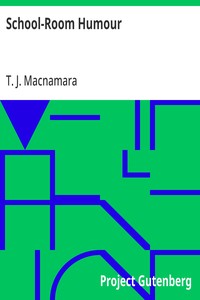
Before opening School-Room Humour — A Closer Reading, the edition data offers a quick orientation: 27,747 words, 2 hr 1 min estimated reading time, and 4 detected text sections.
The text analysis averages about 14.4 words per sentence, while the detected sections provide another way to judge how the source is divided.
Project Gutenberg metadata also associates the work with “English wit and humor,” connecting these edition facts with the source record’s subject description.
Explore this collection
These alternatives are selected using recorded categories and estimated reading time.
About 104 minutes
Schools Learning
23,846 recorded words. 17 minutes difference from this book's estimate.
View Gutenberg source #31367About 82 minutes
Schools Learning
18,703 recorded words. 39 minutes difference from this book's estimate.
View Gutenberg source #24786About 63 minutes
Schools Learning
14,484 recorded words. 58 minutes difference from this book's estimate.
View Gutenberg source #22035Search stored excerpts and compare books → Choose by your preferences →
Choices use stored catalog measurements. Estimates vary with reading speed. A shared category is a catalog label, not a claim that two books have the same argument or literary quality.
Search reads excerpt text stored with this catalog and links to its associated Gutenberg record. The connection is stored in the site database; this tool does not recheck that every excerpt is word-for-word identical to that external record. Excerpt search does not cover every chapter and does not verify historical publication dates.
Catalog snapshot checked: 2026-09-25. Coverage: 96 public books, 96 available source excerpts.
Calculated from edition completeness, EPUB availability, text structure and catalogue metadata. Not a user rating.
Total of 100 points, scaled to a 2.5-5.0 range. Editions with an empty description or a missing EPUB file are not scored.
Public-domain source text
The source text is kept in the dedicated reader, separate from this catalogue record and its commentary.
Dr. Macnamara's School-Room Humour opens with a teacher asking what B.C. stands for, and a scholar replying "Before Christ!"—then, asked what B.A. stands for, answering "Before Adam!" This pattern of logical misstep sets the tone for a collection built on the gap between adult expectation and child reasoning. The book is structured not as a narrative but as a series of themed chapters, each gathering anecdotes from teachers across Britain. Macnamara, a former schoolmaster and Member of Parliament, thanks the directors of the Schoolmaster and his teacher friends for the material. The result is a documentary record of classroom humour at the turn of the century, preserved in the voices of both pupils and parents.
The book is divided into eight chapters, each with a distinct focus. After a general disquisition, Macnamara moves through children's witticisms, quaint definitions, letters home, religious confusion, parental complaints, scientific howlers, and a miscellaneous section. This arrangement allows the reader to see patterns across categories: the same kind of misunderstanding appears in definitions of gravity and in notes about eczema. The chapters are not essays but anthologies, with each anecdote standing alone. The preface to the second edition notes that Macnamara added "the best from my collection since the first publication," suggesting the book grew by accretion rather than design. The third edition adds a picture cover but no new content. This structure makes the book easy to dip into, but also reveals the compiler's method of gathering and sorting material from multiple sources.
One of the most vivid recurring elements is the parent's excuse note. These letters appear in several chapters, and they share a distinctive voice: phonetic spelling, missing punctuation, and a blend of deference and defiance. A grandmother writes that her granddaughter "suffer with a bad feat" and has "had 2 wounds an it." Another parent threatens: "if you dont give it to him by fair means you shall by foul." The notes often contain malapropisms—"Inflamation in the Consols" for inflammation of the consols (a type of government bond)—and reveal the economic pressures behind absences: children stay home to help with herring or haymaking. These letters are not presented as jokes at the parents' expense; they are evidence of a system where written communication between home and school was fraught with difficulty. The humour lies in the gap between intention and execution, but the notes also document real social conditions.
The book moves fluidly between the classroom and the domestic sphere. A chapter on "Little Scientists at Sea" gives us a child's definition: "Gravity was discovered by Isaac Walton. It is chiefly noticeable in the autumn when the apples are falling from the leaves." This is pure classroom humour, relying on the teacher's knowledge of the correct answer. But the next chapter might contain a parent's letter about a child's illness, written from the kitchen table. The juxtaposition creates a layered picture: the teacher hears one version of events, the parent another. Macnamara does not comment on these contrasts; he simply places them side by side. The effect is to show that school-room humour is not confined to the school-room. It spills out into notes, into home conversations, and into the very language families use to describe their lives. The movement between scenes is abrupt, but it mirrors the way humour itself travels across boundaries.
Throughout the collection, the child's voice is preserved in short bursts. A young geographer declares: "If the earth did not revolt it would be either all equal days or all equal nights." The word "revolt" instead of "revolve" is a classic confusion, but it also suggests a child's imaginative grasp of the concept—the earth as a rebellious body. Another child, asked for a definition of faith, offers: "Faith is what makes you believe what you know to be untrue." This epigram appears on the title page, and it captures the book's central insight: children often arrive at unexpected truths through error. Macnamara does not correct these mistakes; he presents them as artefacts. The humour is gentle, but it is also analytical. By collecting these utterances, he creates a record of how children process the language of instruction. The voice is never sentimentalised; it is simply quoted, with all its misspellings and logical leaps intact.
Readers approaching School-Room Humour should treat it as a primary source rather than a joke book. The humour is period-specific, and some references—like "Consols" or the role of the attendance officer—may require context. But the book rewards attention to the details of language and social history. It is best read in short sessions, letting each anecdote stand on its own. The structure is loose, so there is no need to read straight through. Instead, follow a theme: trace the notes from parents, or the scientific howlers, and watch how the same patterns recur. Macnamara's collection is a quiet archive of voices that would otherwise be lost.
There’s something tender about old schoolbooks—the way a child’s honest mistake can still make you smile, years later. I felt that gentle warmth again reading School-Room Humour, and it reminded me of how another quiet book, The Training of a Forester — A Closer Reading, lingers with the same patient affection for its subject, almost like a fond memory you didn’t know you’d kept.
Build a private reading journal entry for this title.