About 121 minutes
School-Room Humour — A Closer Reading
Schools Learning
27,747 recorded words. 17 minutes difference from this book's estimate.
View Gutenberg source #40593
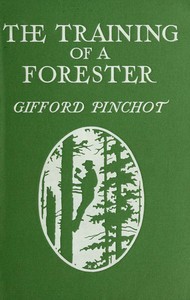
This digital edition of The Training of a Forester — A Closer Reading is described by source-level measurements including 23,846 words, 1 hr 44 min estimated reading time, and 4 detected text sections.
The text analysis averages about 30.5 words per sentence, while the detected sections provide another way to judge how the source is divided.
Project Gutenberg metadata also associates the work with “Forests and forestry,” connecting these edition facts with the source record’s subject description.
Explore this collection
These alternatives are selected using recorded categories and estimated reading time.
About 121 minutes
Schools Learning
27,747 recorded words. 17 minutes difference from this book's estimate.
View Gutenberg source #40593About 82 minutes
Schools Learning
18,703 recorded words. 22 minutes difference from this book's estimate.
View Gutenberg source #24786About 63 minutes
Schools Learning
14,484 recorded words. 41 minutes difference from this book's estimate.
View Gutenberg source #22035Search stored excerpts and compare books → Choose by your preferences →
Choices use stored catalog measurements. Estimates vary with reading speed. A shared category is a catalog label, not a claim that two books have the same argument or literary quality.
Search reads excerpt text stored with this catalog and links to its associated Gutenberg record. The connection is stored in the site database; this tool does not recheck that every excerpt is word-for-word identical to that external record. Excerpt search does not cover every chapter and does not verify historical publication dates.
Catalog snapshot checked: 2026-09-25. Coverage: 96 public books, 96 available source excerpts.
Calculated from edition completeness, EPUB availability, text structure and catalogue metadata. Not a user rating.
Total of 100 points, scaled to a 2.5-5.0 range. Editions with an empty description or a missing EPUB file are not scored.
Public-domain source text
The source text is kept in the dedicated reader, separate from this catalogue record and its commentary.
Gifford Pinchot opens The Training of a Forester with a direct challenge: he urges no man to make forestry his profession, but rather to keep away from it if he can. This cautionary note, rare in career guides, sets the tone for a book that is as much a self-assessment tool as an introduction. Pinchot, the first Chief of the U.S. Forest Service, writes from experience, having shaped the very agency he describes. The text moves briskly from the Forester's daily tasks—fire lookout, timber cruising, law enforcement—to the administrative machinery in Washington, all while stressing that forestry demands a specific blend of character, mind, and body. The excerpts reveal a writer who prizes efficiency, duty, and a love for the outdoors above all, and who is unafraid to warn off the uncommitted.
Pinchot frames forestry as a calling, not a fallback. In the preface, he states that for those it suits, forestry offers a career more attractive than any other, yet he immediately adds that those who began study and then left are likely more numerous than those who persisted. This binary framing—either altogether at home or very much out of place—recurs throughout the excerpts. The book does not promise easy success; instead, it emphasizes that the profession punishes the ill-suited. Pinchot’s language is blunt: he urges no man to make forestry his profession unless he has a compelling love for the Forester's life and work. This insistence on self-selection is a defining feature of the text, distinguishing it from more boosterish career guides of the era.
The excerpts detail the structure of the Forest Service with administrative precision. Pinchot describes the Forester’s role in Washington: general supervision, policy determination, budget preparation, and defending the Service before Congress. He notes that immediate subordinates spend much time in the field inspecting work and keeping its tone high. The text also catalogs state-level forestry efforts, listing appropriations for fire protection—Pennsylvania leading with $275,000 for chestnut blight—and the number of states with forest nurseries, which in 1912 produced twenty million young trees. These concrete figures ground the book in the practical realities of early twentieth-century conservation, showing a profession still building its institutions.
Pinchot devotes chapters to what a forester must know and the perspective he must adopt. The table of contents lists sections on the Forester’s Knowledge, the Forest and the Nation, and the Forester’s Point of View, though the excerpts do not include their full text. However, the preface and later passages make clear that this knowledge is not merely technical but includes a sense of public service and efficiency. Pinchot writes that the Forester keeps his hand upon the whole machinery of the Service, holding it up to its work and supplying it with the right spirit and point of view, without which any kind of efficiency is impossible. This emphasis on spirit and point of view suggests that the book treats forestry as a moral and civic enterprise as much as a scientific one.
Readers approaching The Training of a Forester should note its dual purpose: it is both a practical handbook for the aspiring forester and a piece of institutional advocacy from the man who built the U.S. Forest Service. Pinchot’s voice is authoritative, sometimes stern, and always focused on the real conditions of the work. The book rewards attention to its administrative details and its frank assessment of who should—and should not—pursue this path. For those interested in the history of conservation or early twentieth-century professional life, it offers a primary-source view of how one influential figure defined a profession.
There’s something touching about the way Gifford Pinchot warns young foresters that the work must call to you, not merely pay you. It made me think of those old rhythm plays, where children learn the shape of a story before they can name it. Dramatized Rhythm Plays Mother Goose and Traditional — Story, Setting & Ideas holds that same quiet faith—that love of the thing itself, played out in small, repeated steps.
A brief reflection can help important ideas stay with you longer.