About 319 minutes
Schools of to-morrow — A Closer Reading
Schools Learning
73,173 recorded words. 45 minutes difference from this book's estimate.
View Gutenberg source #48906
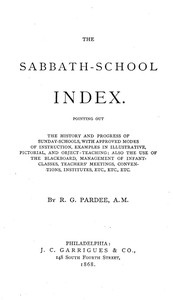
The source record for The Sabbath-School Index Pointing out the history and progress of Sunday-schools, with approved modes of instruction. — Story, Setting & Ideas measures this digital text at 62,888 words, 4 hr 34 min estimated reading time, and 9 detected text sections.
The text analysis averages about 17.3 words per sentence, while the detected sections provide another way to judge how the source is divided.
Project Gutenberg metadata also associates the work with “Sunday schools,” connecting these edition facts with the source record’s subject description.
Explore this collection
These alternatives are selected using recorded categories and estimated reading time.
About 319 minutes
Schools Learning
73,173 recorded words. 45 minutes difference from this book's estimate.
View Gutenberg source #48906About 223 minutes
Schools Learning
51,186 recorded words. 51 minutes difference from this book's estimate.
View Gutenberg source #61956About 197 minutes
Schools Learning
45,135 recorded words. 77 minutes difference from this book's estimate.
View Gutenberg source #15923Search stored excerpts and compare books → Choose by your preferences →
Choices use stored catalog measurements. Estimates vary with reading speed. A shared category is a catalog label, not a claim that two books have the same argument or literary quality.
Search reads excerpt text stored with this catalog and links to its associated Gutenberg record. The connection is stored in the site database; this tool does not recheck that every excerpt is word-for-word identical to that external record. Excerpt search does not cover every chapter and does not verify historical publication dates.
Catalog snapshot checked: 2026-09-25. Coverage: 96 public books, 96 available source excerpts.
Calculated from edition completeness, EPUB availability, text structure and catalogue metadata. Not a user rating.
Total of 100 points, scaled to a 2.5-5.0 range. Editions with an empty description or a missing EPUB file are not scored.
Public-domain source text
The source text is kept in the dedicated reader, separate from this catalogue record and its commentary.
R. G. Pardee’s The Sabbath-School Index (1868) is a practical manual that compiles “approved modes of instruction” for Sunday-school teachers, superintendents, and pastors. Rather than a theoretical treatise, it offers concrete examples: transcribed classroom dialogues, blackboard diagrams, and object lessons. One excerpt shows a teacher leading a lesson on the Passover by drawing door-frames on a board with red chalk, drilling students on which houses the angel would “pass over.” Another uses the image of a steam engine to explain the “place of power” in the heart where Christ knocks. These vignettes reveal a method that combines repetition, visual aids, and emotional appeal.
Pardee devotes an entire chapter to the blackboard, and the excerpts demonstrate its centrality. In one lesson, the teacher draws “three or four door-frames” and uses red chalk to mark blood on two, then asks the class to identify which houses the angel would enter. This visual drill fixes the biblical fact “impressively and perfectly into the scholars’ minds.” The blackboard is not merely decorative; it is a device for repetitive, interactive testing. The teacher also uses the board to sketch an engine, tracing the path of the express train to illustrate the “place of power.” These examples show that Pardee valued the blackboard as a tool for making abstract theological concepts—atonement, salvation, obedience—concrete and memorable for children.
The transcribed lessons reveal a highly interactive, call-and-response style. The teacher asks rapid questions: “What drew the cars? An engine. Did you ever see an engine? Yes, sir!” Students answer in unison or individually, and the teacher repeats key phrases—“the blood,” “the door,” “the place of power”—multiple times. This method aims to drill facts and interpretations into memory. In the Passover lesson, the teacher checks understanding by asking what would happen if the basin were “set behind the door” or if a child cut a finger and sprinkled blood on the house. The students’ emphatic “No, sir!” responses show that the technique is designed to correct misconceptions and reinforce the correct theological meaning.
Pardee’s manual advocates using familiar objects to teach spiritual truths. The steam engine lesson is a prime example: the teacher describes the express train’s approach, the whistle, and the engineer’s hand on the “little iron bar” that controls the engine. This leads to the analogy of Jesus knocking at the heart’s door and the need for “blood” on that door. The teacher also references the Civil War: “Why did our soldiers go off to the war? To fight; yes, and to shed their—blood—for their country.” This connects sacrifice for nation to Christ’s sacrifice. Such object lessons ground theology in the child’s immediate world, making abstract doctrines tangible through comparison with trains, soldiers, and household items.
Readers approaching The Sabbath-School Index should treat it as a period-specific handbook, not a modern curriculum. The methods—blackboard drills, repetitive questioning, and object lessons—reflect mid-nineteenth-century educational theory and evangelical priorities. Pay attention to the detailed transcripts: they reveal not only what was taught but how teachers managed attention, corrected errors, and built emotional intensity. The book is best read as a primary source for the history of religious education in America.
Leafing through old Pardee’s manual, I kept thinking how those blackboard exercises were a kind of handwork, a way to make ideas tangible. That quiet thought lingered, nudging me toward an older curiosity about craft as learning itself. The connection felt less like a formal study, more like remembering a path I’d once wandered. Hand-Craft: The Most Reliable Basis of Technical Education in Schools and Classes — A Closer Reading carries that same gentle, earnest pulse.
Answer a few questions and save a private reflection on this device.