About 34 minutes
The educated Negro and his mission — Themes and Context
Teaching Methods
7,764 recorded words. 5 minutes difference from this book's estimate.
View Gutenberg source #31255
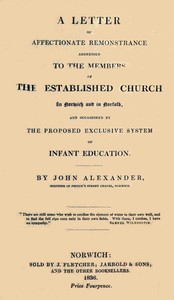
This digital edition of A Letter of affectionate remonstrance addressed to the members of the Established Church in Norwich and in Norfolk and occasioned by the proposed exclusive system of — Story, Setting & Ideas is described by source-level measurements including 6,625 words, 29 min estimated reading time, and 1 detected text section.
The text analysis averages about 31.0 words per sentence, while the detected sections provide another way to judge how the source is divided.
Project Gutenberg metadata also associates the work with “Church and education -- England,” connecting these edition facts with the source record’s subject description.
Explore this collection
These alternatives are selected using recorded categories and estimated reading time.
About 34 minutes
Teaching Methods
7,764 recorded words. 5 minutes difference from this book's estimate.
View Gutenberg source #31255About 40 minutes
Teaching Methods
9,101 recorded words. 11 minutes difference from this book's estimate.
View Gutenberg source #22604About 65 minutes
Teaching Methods
14,948 recorded words. 36 minutes difference from this book's estimate.
View Gutenberg source #46378Search stored excerpts and compare books → Choose by your preferences →
Choices use stored catalog measurements. Estimates vary with reading speed. A shared category is a catalog label, not a claim that two books have the same argument or literary quality.
Search reads excerpt text stored with this catalog and links to its associated Gutenberg record. The connection is stored in the site database; this tool does not recheck that every excerpt is word-for-word identical to that external record. Excerpt search does not cover every chapter and does not verify historical publication dates.
Catalog snapshot checked: 2026-09-25. Coverage: 96 public books, 96 available source excerpts.
Calculated from edition completeness, EPUB availability, text structure and catalogue metadata. Not a user rating.
Total of 100 points, scaled to a 2.5-5.0 range. Editions with an empty description or a missing EPUB file are not scored.
Public-domain source text
The source text is kept in the dedicated reader, separate from this catalogue record and its commentary.
John Alexander, minister of Prince’s Street Chapel, Norwich, published this open letter in 1836 to oppose a proposed exclusive infant school system for the Church of England. The letter is addressed directly to members of the Established Church in Norwich and Norfolk, adopting a tone of “affectionate remonstrance” that blends pastoral concern with firm argument. Alexander anchors his case in the writings of Samuel Wilderspin, a prominent infant school advocate, quoting him extensively to show that the “originator of Infant schools” rejected sectarian control. The pamphlet’s structure moves from a specific local advertisement to broader principles, using Wilderspin’s experiences in towns like Taunton and Sheffield as evidence that mixed committees of Churchmen and Dissenters can succeed harmoniously.
The pamphlet opens by noting an anonymous advertisement in Norwich papers calling a meeting to form a Church-only infant school society. Alexander seizes on this anonymity as a weakness, questioning the authority behind the summons. He then widens the scope, arguing that excluding Dissenters contradicts the practice in other towns where “the union between Churchmen and Dissenters is delightful.” By grounding his argument in a specific local event—the meeting scheduled for April 7, 1836—Alexander makes the abstract issue of sectarianism concrete. His method is to test the proposed exclusive system against real outcomes elsewhere, a rhetorical strategy that gives the letter its persuasive force.
Alexander leans heavily on Samuel Wilderspin’s book, quoting passages that praise “freedom from all shackles” and “entire exemption from sectarianism.” He cites Wilderspin’s account of Sheffield, where five schools with nearly a thousand infants operated with “harmony of Churchmen and Dissenters.” The quotations are woven into Alexander’s own prose, creating a layered argument: the expert on infant schools opposes exclusivity, and his practical experience proves that inclusive systems work. Alexander does not merely cite Wilderspin; he positions him as an authority whose observations trump local prejudice. This reliance on a single source gives the letter a focused, almost forensic quality.
Alexander’s tone is carefully calibrated. He calls his readers “Christian Friends” and insists his object is “not to offend, but to convince.” Yet the letter contains sharp phrases: he calls the exclusive proposal “a suicidal act” for the church and dismisses opposing arguments as “too trifling even for ridicule.” This blend of politeness and polemic reflects the pamphlet’s genre—a public letter that must maintain decorum while pressing a contentious point. Alexander also uses biblical language, closing with a quotation from Galatians about “a new creature,” to frame his position as the truly Christian one. The tension between affectionate address and firm remonstrance is the letter’s central stylistic feature.
In the final pages, Alexander shifts from critique to proposal. He urges Dissenters, if excluded, not to retaliate by forming their own exclusive society. Instead, they should call a meeting of “all denominations of Christians who can conscientiously unite” and invite liberal Churchmen to cooperate. He insists that infant schools should teach neither conformity nor nonconformity, but only “the sincere milk of the word.” This positive vision is brief but specific: a mixed committee, a public meeting, and a curriculum free from sectarian doctrine. Alexander thus ends not with a complaint but with a constructive alternative, grounded in the very principle of catholicity he has defended throughout.
Readers approaching this letter for the first time should attend to how Alexander builds his case from a single local advertisement to a general principle. The pamphlet is short—under 7,000 words—and its argument unfolds in a clear sequence: problem, evidence, rebuttal, solution. Pay particular attention to the quoted passages from Wilderspin, which serve as both evidence and emotional appeal. Alexander’s own voice, alternating between pastoral warmth and indignation, gives the letter its distinctive character. This is not a theoretical treatise but a timely intervention in a specific controversy, and its power lies in that immediacy.
Years at this desk teach you how certain books speak to each other across the shelves. Alexander's fierce, gentle plea for children's minds to wander free of sectarian walls always puts me in mind of that quieter volume, A Montessori Mother — Inside the Classic. Both trust the child's own unfolding, trusting patience over prescription. That old Norwich argument feels like a whisper of the same faith. Such kinship is a rare, warming thing.
Save your reaction, strongest insight, and memorable passage.