About 789 minutes
The History of Pedagogy — Background and Themes
Educational Theory
181,286 recorded words. 48 minutes difference from this book's estimate.
View Gutenberg source #62376
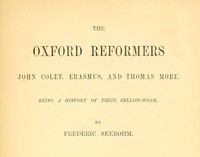
The Oxford Reformers: John Colet, Erasmus, and Thomas More — Background and Themes can be approached with a clearer sense of reading commitment from its source measurements: 170,211 words, 12 hr 21 min estimated reading time, and 29 detected text sections.
The text analysis averages about 20.2 words per sentence, while the detected sections provide another way to judge how the source is divided.
Project Gutenberg metadata also associates the work with “More, Thomas, Saint, 1478-1535,” connecting these edition facts with the source record’s subject description.
Explore this collection
These alternatives are selected using recorded categories and estimated reading time.
About 789 minutes
Educational Theory
181,286 recorded words. 48 minutes difference from this book's estimate.
View Gutenberg source #62376About 651 minutes
Educational Theory
149,514 recorded words. 90 minutes difference from this book's estimate.
View Gutenberg source #16510About 554 minutes
Educational Theory
127,383 recorded words. 187 minutes difference from this book's estimate.
View Gutenberg source #10985Search stored excerpts and compare books → Choose by your preferences →
Choices use stored catalog measurements. Estimates vary with reading speed. A shared category is a catalog label, not a claim that two books have the same argument or literary quality.
Search reads excerpt text stored with this catalog and links to its associated Gutenberg record. The connection is stored in the site database; this tool does not recheck that every excerpt is word-for-word identical to that external record. Excerpt search does not cover every chapter and does not verify historical publication dates.
Catalog snapshot checked: 2026-09-25. Coverage: 96 public books, 96 available source excerpts.
Calculated from edition completeness, EPUB availability, text structure and catalogue metadata. Not a user rating.
Total of 100 points, scaled to a 2.5-5.0 range. Editions with an empty description or a missing EPUB file are not scored.
Public-domain source text
The source text is kept in the dedicated reader, separate from this catalogue record and its commentary.
Frederic Seebohm’s The Oxford Reformers opens with three epigraphs—from Colet, Erasmus, and More’s translation of Pico—that immediately signal the work’s concern with truth-seeking and the broadening of Christian practice. The preface to the third edition candidly admits the book is “imperfect” and “antiquated,” yet yields to a friend’s plea that it “may live a little longer.” This self-awareness shapes the narrative: Seebohm weaves together biography and social history, but the excerpts show a strong emphasis on Tudor economic policy, including detailed analysis of taxation on labourers and Wolsey’s legislative maneuvers. The catalog subjects list Reformation, education, and biography, but the text itself devotes considerable space to parliamentary acts and peasant ejections, suggesting a broader socio-political lens than the metadata implies.
The three epigraphs preceding the main text are not decorative. Colet’s words—“Veritatem enim quærimus, non opinionis offensionem”—frame the inquiry as a search for truth, not a defense of opinion. More’s translation of Pico della Mirandola urges the reader to heed “the very law of nature, what thing very reason, what thing Our Lord himself showeth thee to be done.” Erasmus’s question—“Cur sic arctamus Christi professionem quam Ille latissime voluit patere?”—challenges the narrowing of Christian profession. Together, they establish a humanist, reformist stance that Seebohm applies to his subjects’ educational and religious projects. The excerpts do not show how these mottos are developed, but their placement suggests a deliberate thematic anchor.
Despite the catalog classification as biography and educational theory, the excerpts reveal extended passages on Tudor social and economic conditions. Seebohm details an income-tax of sixpence in the pound “descending even to the wages of the farm-labourer,” and criticizes Wolsey’s Parliament for re-enacting “a rigid scale of wages” while exempting employers. He notes the “wholesale ejections” of peasants due to pasture farming and the “appalling increase of crime” leading to more executions. These sections read more like social history than personal narrative, indicating that Seebohm’s concept of “fellow-work” includes the political context in which his reformers operated. The metadata’s focus on individuals may understate the book’s structural critique of Tudor governance.
Seebohm’s prefaces document a process of revision driven by new evidence. The second edition acknowledges “the remarkable discovery by Mr. W. Aldis Wright” of a family register that clarified the chronology of More’s early life, forcing a “slight alteration” to the title. The third edition notes that Dean Colet’s works have been “ably edited by my friend Mr. Lupton,” and that a new biography is in press. These remarks show Seebohm positioning his work as provisional, subject to correction by later scholarship. They also reveal a network of contemporary researchers—Lupton, Wright—whose findings shaped the book’s evolution. Readers should note that the text’s claims about dates or events may reflect pre-1887 knowledge.
Seebohm’s Oxford Reformers is best approached as a document of its own historiographical moment. The author’s frankness about the book’s limitations, combined with his detailed treatment of Tudor economic policy, offers a layered portrait of the reformers’ world. Readers interested in the intellectual biography of Colet, Erasmus, and More will find the core narrative, but those seeking a critique of early modern governance will also be rewarded. The epigraphs provide a concise entry point into the humanist values Seebohm attributes to his subjects.
Years at this desk have taught me how one book can echo another. Seebohm’s study of Colet, Erasmus, and More carries a gentle urgency about making scripture live in young minds. Flipping through A Manual for Teaching Biblical History — A Reader’s Guide, I find the same warmth, the same patient hope that learning can be both faithful and free. A quiet kinship, indeed.
Your answers remain private and are stored only in this browser.