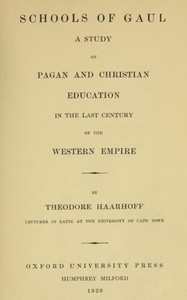
Schools of Gaul in the last century of the Western Empire — Key Ideas to Explore

(0 User reviews)   280
In Category - Schools Learning
Haarhoff, T. J. (Theodore Johannes), 1892-1971 Project Gutenberg 2023 Not confirmed
Education, Ancient -- France; Gaul -- History -- 58 B.C.-511 A.D. Readers of public-domain and historical texts
Project Gutenberg digital edition en

Edition facts

Words 98,386
Reading time 428 min
Text sections 32

The source record for Schools of Gaul in the last century of the Western Empire — Key Ideas to Explore measures this digital text at 98,386 words, 7 hr 8 min estimated reading time, and 32 detected text sections.

The text analysis averages about 16.9 words per sentence, while the detected sections provide another way to judge how the source is divided.

Project Gutenberg metadata also associates the work with “Education, Ancient -- France,” connecting these edition facts with the source record’s subject description.

An analysis of authorial choices in diction, dialogue, and description within Haarhoff's study of pagan and Christian education in 4th-5th century Gaul, focusing on how rhetorical strategies and lexical patterns reveal the tensions and continuities between classical and emerging Christian pedagogical traditions.
Share
Editorial Edition Score 4.9/5

Calculated from edition completeness, EPUB availability, text structure and catalogue metadata. Not a user rating.

How this score is calculated
  • Description quality20 pts
  • Title & short description10 pts
  • Source metadata20 pts
  • Text length15 pts
  • Chapters / structure15 pts
  • EPUB file integrity20 pts

Total of 100 points, scaled to a 2.5-5.0 range. Editions with an empty description or a missing EPUB file are not scored.

Edition quality

Read the Text

ying out, and had no racial background, but the effects of a wrong handling of ‘the second language’ are as unmistakable and instructive. It is not time or place or circumstance that matters in educational method so much as psychology—a study that is only beginning to come into its heritage—and the psychology of the child is the same yesterday as to-day.

To us the language question in Gaul is interesting from another point of view too. The Romans did the world a great service by keeping their language uniform. This they did chiefly by means of their law, which was understood throughout the Roman world, and by means of their professors, who, like the Panegyrists in Gaul during the fourth century A.D., handed down a language which remained for centuries very similar to that of Cicero. But a time came when this attempt failed. When Christian teaching became strong and widespread, it was found that to the bulk of the people the polished rhetoric of the schools had become strange. In order to touch the understanding of their flock, the bishops were constrained (with sore travail, for at heart they were proud of their pagan education) to discard the style of speech in which they had been trained, and to come closer to the idiom of the masses. So in South Africa it has been officially recognized that the language of Holland has become strange to the school-child, and that in order to reach his intelligence we must use the offspring of Holland Dutch, Afrikaans—moulded, since 1652, to a vastly different climate, scenery, and national character. How this attempt is to be made, and what its danger is in the direction of formlessness—these are questions for which something may be gleaned from a consideration of the Latin of the Fathers. Art is needed and scientific interest. For lack of these the vivid language of Tertullian and the early Fathers degenerated later into formlessness. And our problem to-day is to watch over the form that is taking shape, make clear its scientific basis, and beautify it by spreading an interest in Art.

Finally, the Gauls witnessed the breaking up of governments and its consequent disorders. They were faced, as we are, by the problem of ‘Bolshevism’, though in their case it merely took the shape of the marauding Vargi and the Bagaudae. The influence of a disordered society on education was felt then as now. With us there are some who, like Avitus of Vienne, _in malis ferventibus_, despair of any end to the troubles which throng around them, while the wiser sort will rather urge with the author of the _De Providentia Dei_ that, despite disappointments,

‘Invictum deceat studiis servare vigorem’.

This study has been based, as far as possible, directly on original authorities, who have been neglected largely because they fall in a period which the pedant has called ‘unclassical’ and which is yet not definitely ‘modern’. I have found many statements in modern books relating to this period which need modification or correcting, and I feel sure that this essay has merely touched a field that deserves more attention than it has hitherto received.

Among those to whom my gratitude is due, I wish to mention particularly my tutor, Professor E. W. Watson of Christ Church, Professor J. A. Smith of Magdalen, Professor Percy Gardner, who read the archaeological part, Professor Gilbert Murray, whose suggestions were helpful and inspiring, and the examiners of this essay when it was put forward as a thesis at Oxford. Professor Haverfield and Mr. R. L. Poole, through whose influence it was accepted for publication. Since then the material has been considerably revised and amplified. For help in the dreary work of reading the proofs, I must record my thanks to my old and trusted guide, Professor William Ritchie, of the University of Cape Town, and to my wife. And there is one whose memory I must always cherish, in this as in other spheres, with the deepest affection and gratitude—my former tutor, the late Mr. H. J. Cunningham of Worcester. His encouragement and counsel were invaluable, and his readiness to assist one of the pleasantest memories of my work.

I wish to acknowledge the courtesy of the Rhodes Trustees in allowing me to use part of my scholarship to defray the expenses of publication; and I must not fail also to put on record the financial assistance given me by the Government Research Grant Board of the Union of South Africa. Such assistance is not inappropriate for a book that deals so largely with State support of education, and it is the more pleasing in view of the growing interest of the Government in research.

Haarhoff's prose in Schools of Gaul is marked by a deliberate rhetorical balance: he frequently pairs contrasting terms—'Pagan and Christian,' 'Roman and Barbarian'—to frame the period as one of synthesis rather than rupture. His diction often carries a modernizing impulse, as when he describes the age as 'like our own, of transition,' a phrase that invites the reader to see parallels without overstating them. The author's use of direct Latin quotations (e.g., ut quisque suo magis ingenio voluntarius acquiratur Deo) serves not merely as evidence but as a stylistic device that anchors his argument in primary voices, while his own commentary remains measured, avoiding hyperbole.

Rhetorical Framing of Transition

Haarhoff opens his preface with a series of binary oppositions—'Roman and Barbarian, Pagan and Christian'—that immediately establish the central tension of his study. This rhetorical strategy is not merely organizational; it reflects his thesis that education in late antique Gaul was a site of negotiation rather than simple replacement. The phrase 'movements and counter-movements' suggests a dynamic, almost dialectical process, and he reinforces this by describing the period as 'an age, like our own, of transition.' The choice of 'transition' over 'decline' or 'fall' is significant: it implies continuity and evolution, not catastrophe. Throughout the excerpts, Haarhoff maintains this balanced tone, even when discussing conflicts between Christian exclusivists and moderates. He uses verbs like 'supplemented' and 'passed through' to describe the relationship between pagan and Christian education, avoiding language of conquest or supersession. This lexical choice shapes the reader's understanding of the period as one of gradual integration.

The Use of Latin Quotations as Evidence and Style

Haarhoff integrates Latin quotations not as mere citations but as integral parts of his argumentative prose. For instance, he quotes Jerome's praise of Paulinus's panegyric—'His style is brilliant with Ciceronian purity, yet copious in thought'—to illustrate how Christian writers adopted classical rhetorical standards. The Latin phrase ut quisque suo magis ingenio voluntarius acquiratur Deo is given without translation, assuming a learned readership, and it encapsulates a key liberal Christian attitude toward pagan literature. These quotations serve a dual purpose: they provide documentary evidence and they echo the rhetorical cadences of the sources, lending Haarhoff's own writing an authoritative, scholarly tone. Notably, he often follows a quotation with a brief gloss or contextual remark, as when he notes that Jerome 'is enthusiastic in his praise of the speech,' thereby guiding interpretation without over-explaining. This technique respects the reader's intelligence while ensuring the evidence is clearly tied to his argument.

Descriptive Economy in Characterizing Historical Figures

Haarhoff's descriptions of historical figures are concise and functional, focusing on their intellectual positions rather than personal details. For example, he characterizes the Apollinarii simply as 'Christian teachers of Laodicea' who 'turned the Old Testament into heroic verse and the New Testament into Platonic dialogues.' The description is stripped of biography, emphasizing the pedagogical innovation. Similarly, Augustine is said to have 'brought Plato into the (Christian) schools under his bishop's robe,' a vivid metaphor that condenses a complex cultural transfer into a single image. Jerome is described as 'expounding lyric and comic poets to the children at Bethlehem,' a detail that highlights the practical integration of pagan texts into Christian education. These descriptions are economical—often a single clause—yet they convey the essence of each figure's contribution. Haarhoff avoids evaluative adjectives like 'great' or 'influential,' letting the actions speak for themselves. This restraint aligns with his scholarly tone and keeps the focus on the educational practices rather than on hagiography.

Structural Patterns in Argumentation

Haarhoff organizes his chapters around a clear problem-solution structure, often beginning with a tension and then presenting evidence of resolution. In the excerpt on Christian attitudes toward pagan literature, he first states the conflict: 'the wiser among the Christians opposed the policy of exclusiveness.' He then provides a series of examples—the Apollinarii, Juvencus, Nonnus—that demonstrate how Christian writers adapted classical forms. The paragraph concludes with a broader claim: 'it was the Church alone that could have saved the form and content of the ancient culture.' This pattern recurs: a thesis statement, a list of supporting instances, and a summarizing reflection. The lists are often introduced with 'Thus' or 'So,' creating a logical flow. Haarhoff also uses transitional phrases like 'At the same time' and 'In spite of' to acknowledge counterarguments, as when he notes the 'hypocrisy in the railing of the Christian writers against the pagan authors.' This dialectical structure mirrors the synthesis he describes, making the form of the argument reflect its content.

Haarhoff's study rewards attention to his own authorial choices: the balanced diction, the strategic use of Latin quotations, and the economical descriptions all work together to present a nuanced picture of educational change. Readers may find it useful to note how his prose style itself embodies the synthesis he describes—classical rhetorical structures carrying a Christian argument. The book is best approached as a scholarly essay in argumentation, where the evidence is carefully selected and the language is as deliberate as the thesis.

This reminded me of sitting with my father’s old Latin primer, the margins filled with his pencil notes, and how he’d murmur declensions like lullabies. There is a strange tenderness in those fifth-century classrooms, the same warmth I felt years later while reading Dramatized Rhythm Plays Mother Goose and Traditional — Story, Setting & Ideas, where learning becomes a remembered game. Both feel like voices carried quietly from one childhood to another.

There are no reviews for this eBook.

0
0 out of 5 (0 User reviews )

Add a Review

Your Rating *
There are no comments for this eBook.

Reader reflection

How will you remember this book?

Save your reaction, strongest insight, and memorable passage.

Your progress 0 / 10
1

What is your current status with this title?

2

How much did you enjoy the reading experience?

3

Would you encourage someone else to read it?

4

How demanding did the text feel?

Related eBooks