About 36 minutes
C.A. Coey's School of Motoring, 1424-26 Michigan Ave. Chicago — Edition Insights
Educational Theory
8,123 recorded words. 0 minutes difference from this book's estimate.
View Gutenberg source #49307
Before opening Finger plays for nursery and kindergarten — Story, Setting & Ideas, the edition data offers a quick orientation: 8,112 words, 36 min estimated reading time, and 2 detected text sections.
The text analysis averages about 17.5 words per sentence, while the detected sections provide another way to judge how the source is divided.
Project Gutenberg metadata also associates the work with “Games,” connecting these edition facts with the source record’s subject description.
Explore this collection
These alternatives are selected using recorded categories and estimated reading time.
About 36 minutes
Educational Theory
8,123 recorded words. 0 minutes difference from this book's estimate.
View Gutenberg source #49307About 32 minutes
Educational Theory
7,212 recorded words. 4 minutes difference from this book's estimate.
View Gutenberg source #56About 43 minutes
Educational Theory
9,729 recorded words. 7 minutes difference from this book's estimate.
View Gutenberg source #31323Search stored excerpts and compare books → Choose by your preferences →
Choices use stored catalog measurements. Estimates vary with reading speed. A shared category is a catalog label, not a claim that two books have the same argument or literary quality.
Search reads excerpt text stored with this catalog and links to its associated Gutenberg record. The connection is stored in the site database; this tool does not recheck that every excerpt is word-for-word identical to that external record. Excerpt search does not cover every chapter and does not verify historical publication dates.
Catalog snapshot checked: 2026-09-25. Coverage: 96 public books, 96 available source excerpts.
Calculated from edition completeness, EPUB availability, text structure and catalogue metadata. Not a user rating.
Total of 100 points, scaled to a 2.5-5.0 range. Editions with an empty description or a missing EPUB file are not scored.
Public-domain source text
The source text is kept in the dedicated reader, separate from this catalogue record and its commentary.
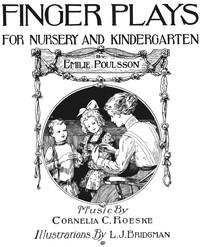
Emilie Poulsson’s Finger Plays for Nursery and Kindergarten (1893) presents eighteen coordinated activities that pair short verses with specific hand motions, each accompanied by a musical setting from Cornelia C. Roeske. The book opens with a Froebel epigraph—"What the child imitates, he begins to understand"—which frames the plays as tools for cognitive development rather than mere entertainment. Poulsson’s preface notes that finger plays have been "a delight of childhood" across cultures, citing the familiar "Here is the church" as an example. She also claims that the motions can assist "the development of strength and flexibility in the tiny lax fingers" and serve as "the first awakening call" to dormant thought. The volume includes detailed illustrations by L.J. Bridgman, which Poulsson describes as "charming and expressive."
Three consecutive plays—"How the Corn Grew," "The Mill," and "Making Bread"—trace a single foodstuff from planting to consumption, each building on the previous step. "How the Corn Grew" opens with a field "all hard and brown and bare" and proceeds through ploughing, harrowing, planting, rain, crows, harvest, and the song of "Harvest Home." "The Mill" personifies a river that "went singing day by day" until it reaches a mill-dam, then turns a wheel that grinds corn "to golden meal" and wheat "to flour." "Making Bread" shows the mother sifting flour "white as snow," adding yeast, kneading, and baking. The sequence reinforces cause-and-effect and the labor behind a common food, a pattern that aligns with Froebel’s idea that imitating work leads to understanding its meaning.
Each finger play is set to music composed by Cornelia C. Roeske, with the digital edition providing MIDI, PDF, and MusicXML files. The verses use consistent meter and rhyme—for example, "A merry little river / Went singing day by day"—which makes them easy to chant or sing while performing the gestures. Poulsson notes that some plays suit babies as young as ten months, who "pound and clap gleefully," while older children enjoy more complex ones like "The Caterpillar." The combination of sung words, hand movements, and narrative sequence creates a multisensory experience that reinforces vocabulary and story structure. The music is not merely decorative; it sets the tempo for the motions and helps children anticipate the next action.
L.J. Bridgman’s illustrations are integral to the book’s design, as Poulsson urges readers to study them for guidance on the hand motions. The preface mentions that the pictures are "charming and expressive," and the table of contents notes that the image for "The Lambs" is missing in the original, indicating that each play had a dedicated illustration. The digital edition advises viewing the pictures at "normal or medium text size" for best effect. These images likely show the exact finger positions for each verse, serving as a visual script. By linking the abstract words to concrete visual and kinesthetic actions, the illustrations help bridge the gap between hearing a story and physically enacting it, a method consistent with Froebel’s emphasis on learning through imitation.
Readers may find it useful to first review the illustrations and music for a play before attempting the motions with a child. The plays vary in complexity, so starting with simpler ones like "All for Baby" can build confidence. The sequential grouping of "How the Corn Grew," "The Mill," and "Making Bread" offers a natural unit for exploring how food reaches the table. Because the excerpts do not include all eighteen plays, the full range of themes—such as animals, nature, and daily tasks—remains to be discovered in the complete text.
Holding Poulsson’s little finger plays, I remembered how gently it taught tiny hands to shape a story. It made me think of that other quiet volume, Study of Child Life — Story, Setting & Ideas, which seems to sit beside it on a shelf, sharing the same patient breath—each one trusting a child’s day to unfold slowly, like a rhyme half-remembered.
Save your reaction, strongest insight, and memorable passage.