About 36 minutes
Finger plays for nursery and kindergarten — Story, Setting & Ideas
Educational Theory
8,112 recorded words. 0 minutes difference from this book's estimate.
View Gutenberg source #24912
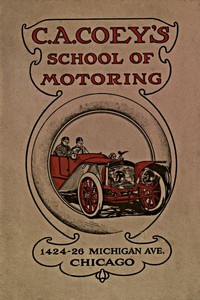
This digital edition of C.A. Coey's School of Motoring, 1424-26 Michigan Ave. Chicago — Edition Insights is described by source-level measurements including 8,123 words, 36 min estimated reading time, and 5 detected text sections.
The text analysis averages about 19.2 words per sentence, while the detected sections provide another way to judge how the source is divided.
Project Gutenberg metadata also associates the work with “Automobile driver education,” connecting these edition facts with the source record’s subject description.
Explore this collection
These alternatives are selected using recorded categories and estimated reading time.
About 36 minutes
Educational Theory
8,112 recorded words. 0 minutes difference from this book's estimate.
View Gutenberg source #24912About 32 minutes
Educational Theory
7,212 recorded words. 4 minutes difference from this book's estimate.
View Gutenberg source #56About 43 minutes
Educational Theory
9,729 recorded words. 7 minutes difference from this book's estimate.
View Gutenberg source #31323Search stored excerpts and compare books → Choose by your preferences →
Choices use stored catalog measurements. Estimates vary with reading speed. A shared category is a catalog label, not a claim that two books have the same argument or literary quality.
Search reads excerpt text stored with this catalog and links to its associated Gutenberg record. The connection is stored in the site database; this tool does not recheck that every excerpt is word-for-word identical to that external record. Excerpt search does not cover every chapter and does not verify historical publication dates.
Catalog snapshot checked: 2026-09-25. Coverage: 96 public books, 96 available source excerpts.
Calculated from edition completeness, EPUB availability, text structure and catalogue metadata. Not a user rating.
Total of 100 points, scaled to a 2.5-5.0 range. Editions with an empty description or a missing EPUB file are not scored.
Public-domain source text
The source text is kept in the dedicated reader, separate from this catalogue record and its commentary.
The booklet opens with a bold claim: the school is "the Greatest and Most Complete AUTO SCHOOL in the World" and uniquely "ACTUALLY BUILDING AUTOMOBILES." This sets a tone of self-promotion that pervades the text, where the school's legitimacy is bolstered by testimonials from racer Barney Oldfield and city officials. The address, 1424-26 Michigan Ave., anchors the operation in Chicago's early automotive hub.
The opening appeal targets young men dissatisfied with their current work or seeking healthful outdoor employment. It promises that chauffeurs enjoy "the esteem and confidence of their wealthy employers" and that many have "started in business for themselves" with employer assistance. The language frames motoring as a stepping stone to wealth, emphasizing "mechanical skill with intellectual effort." Notably, the text addresses "country boys" specifically, suggesting a rural-to-urban migration pattern. The offer of a free automobile after selling ten Coey Flyers reinforces the entrepreneurial angle, blending education with direct sales incentives.
The booklet relies heavily on external endorsements. H.L. Hudson, City Mechanician of Chicago, praises Coey's "vast experience with chauffeurs" and his role as an instructor and examiner. A Chicago Examiner article frames the school as a remedy for "the failure of so many automobiles" and accidents due to driver inefficiency. The Chicago Journal notes Coey's racing and ballooning feats, while the Live Stock Magazine highlights his 1901 school and claims "over one thousand" graduates hold jobs paying up to $75 a week. These testimonials serve as evidence of the school's reputation, though they are clearly selected for promotional effect.
The text describes a system where students first learn "foundation principles in the quiet of his home" through correspondence, then receive a "practical road course." This hybrid model is presented as innovative, allowing nationwide enrollment. The booklet also mentions that the school builds automobiles—the Coey Flyer—which students can sell as agents. This integration of training, sales, and manufacturing suggests a vertically structured business. The emphasis on "properly directed mental work" indicates that the course values theoretical knowledge alongside hands-on skill, a distinction from purely vocational training.
Coey's personal narrative—"commenced as a small farmer boy himself"—is used to inspire trust and ambition. The text repeatedly links learning to drive with upward mobility, claiming that "the compensation of the chauffeur is good" and demand is steady. The offer of a $200 commission per car sold and a free car after ten sales creates a clear financial incentive. The language is direct and persuasive, targeting readers who see motoring as a path to independence. However, the excerpts do not include any actual driving instructions, focusing instead on recruitment and the school's credentials.
Readers should approach this booklet as a primary source on early automotive education and marketing, not as a neutral instructional manual. The blend of salesmanship, testimonials, and career promises reveals how the industry sought to attract workers. The absence of technical content in the excerpts suggests the practical lessons were reserved for enrolled students, making this text a window into the business of motoring schools rather than a guide to driving itself.
Years ago, cataloging a stack of motoring pamphlets, I noticed how C.A. Coey's School of Motoring taught drivers to see the road ahead—patiently, turn by turn. That slow trust in guided steps reminded me of another old friend, The Child and the Curriculum — Themes and Context. Both books whisper the same quiet truth: learning is a journey, not a jump.
Answer a few questions and save a private reflection on this device.