About 493 minutes
Education: How Old The New — Text and Context
Educational Theory
113,377 recorded words. 24 minutes difference from this book's estimate.
View Gutenberg source #34938
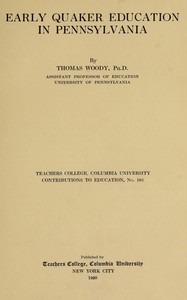
The source record for Early Quaker education in Pennsylvania — Inside the Classic measures this digital text at 107,736 words, 7 hr 49 min estimated reading time, and 38 detected text sections.
The text analysis averages about 20.2 words per sentence, while the detected sections provide another way to judge how the source is divided.
Project Gutenberg metadata also associates the work with “Thesis (Ph. D.),” connecting these edition facts with the source record’s subject description.
Explore this collection
These alternatives are selected using recorded categories and estimated reading time.
About 493 minutes
Educational Theory
113,377 recorded words. 24 minutes difference from this book's estimate.
View Gutenberg source #34938About 554 minutes
Educational Theory
127,383 recorded words. 85 minutes difference from this book's estimate.
View Gutenberg source #10985About 379 minutes
Educational Theory
86,983 recorded words. 90 minutes difference from this book's estimate.
View Gutenberg source #36553Search stored excerpts and compare books → Choose by your preferences →
Choices use stored catalog measurements. Estimates vary with reading speed. A shared category is a catalog label, not a claim that two books have the same argument or literary quality.
Search reads excerpt text stored with this catalog and links to its associated Gutenberg record. The connection is stored in the site database; this tool does not recheck that every excerpt is word-for-word identical to that external record. Excerpt search does not cover every chapter and does not verify historical publication dates.
Catalog snapshot checked: 2026-09-25. Coverage: 96 public books, 96 available source excerpts.
Calculated from edition completeness, EPUB availability, text structure and catalogue metadata. Not a user rating.
Total of 100 points, scaled to a 2.5-5.0 range. Editions with an empty description or a missing EPUB file are not scored.
Public-domain source text
The source text is kept in the dedicated reader, separate from this catalogue record and its commentary.
Thomas Woody's 1920 doctoral dissertation, published as number 105 in Teachers College's Contributions to Education series, opens with a frank admission: manuscript records from preparative meetings 'have not been well kept,' limiting the source base. Yet the work proceeds to reconstruct Quaker schooling in Pennsylvania before 1800 by drawing on minutes, subscription lists, and committee reports from southeastern Pennsylvania depositories. The excerpts show a study grounded in administrative detail—schoolhouse costs estimated at £110, overseers appointed to 'visit the school, examine the progress of the scholars, inspect the teacher’s conduct'—rather than in pedagogical theory.
The excerpts repeatedly illustrate how Quaker meetings managed schools through rotating committees. A 1790 report from Darby Monthly Meeting, for instance, established a formal list of duties for five 'Overseers of Darby School,' including visiting the school, examining scholars, inspecting the teacher, and discharging unruly pupils. The committee could employ and fire teachers only with the meeting's approval, and had to report annually. This structure appears throughout the text: when Benjamin Lobb requested release from service, Morris Truman was appointed 'in his room.' The system was flexible—in 1792 four new overseers were added temporarily, likely to handle increased workload—but always accountable to the monthly meeting.
School construction relied on voluntary subscriptions, not public taxes. In 1793, Benjamin Lobb granted a lot on his plantation for a new schoolhouse, and the overseers proposed that expenses be 'defrayed by subscription.' A subscription was started, and Friends were 'desired to forward it.' The estimated cost was £110. Earlier, a committee including Abraham Bonsall, John Humphreys, and Phillip Price was appointed to enlarge subscriptions before the work could be completed. The excerpts also mention 'trustees of donations given for education of the poor,' who managed permanent funds whose interest was applied to educate needy children. This patchwork of voluntary giving and earmarked donations shaped the financial reality of Quaker schooling.
While the excerpts provide limited direct detail on what was taught, the oversight mechanisms imply a curriculum centered on literacy and religious formation. Committees were to 'examine the progress of the scholars' and 'inspect the teacher’s conduct,' suggesting regular assessment of both learning and moral instruction. The 1784 visit from the quarterly meeting committee focused on 'the establishing and keeping up suitable schools,' checking four criteria: foundation, masters, supervision by committees, and accommodations for the master. A 1790 report noted that the school's status was 'nearly what was expected by the yearly meeting.' The system emphasized accountability through written reports and annual reviews, with the 1787 request for 'a circumstantial account' of schools to be transmitted to the quarterly meeting.
Woody's study is best approached as a documentary history: the value lies in the transcribed minutes, subscription records, and committee reports he assembled from scattered archives. Readers interested in the social mechanics of early American education—how communities actually built and ran schools—will find a wealth of specific, localized evidence. The excerpts suggest that the book's strength is its granular administrative detail rather than broad interpretation.
There’s something steady about those old meeting minutes—how a community quietly decided who would teach, and how much it mattered. It reminds me of that gentler thought in Were You Ever a Child? — Key Ideas to Explore, where childhood isn’t a project but a presence. I keep thinking about that.
Your answers remain private and are stored only in this browser.