About 183 minutes
Were You Ever a Child? — Key Ideas to Explore
Educational Theory
42,022 recorded words. 8 minutes difference from this book's estimate.
View Gutenberg source #57949
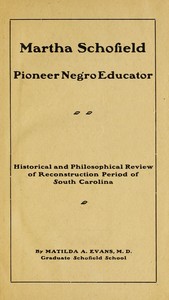
This digital edition of Martha Schofield, pioneer Negro educator Historical and philosophical review of reconstruction period of South Carolina — Text and Context is described by source-level measurements including 43,831 words, 3 hr 11 min estimated reading time, and 21 detected text sections.
The text analysis averages about 31.9 words per sentence, while the detected sections provide another way to judge how the source is divided.
Project Gutenberg metadata also associates the work with “African Americans -- Education,” connecting these edition facts with the source record’s subject description.
Explore this collection
These alternatives are selected using recorded categories and estimated reading time.
About 183 minutes
Educational Theory
42,022 recorded words. 8 minutes difference from this book's estimate.
View Gutenberg source #57949About 207 minutes
Educational Theory
47,455 recorded words. 16 minutes difference from this book's estimate.
View Gutenberg source #75446About 209 minutes
Educational Theory
47,960 recorded words. 18 minutes difference from this book's estimate.
View Gutenberg source #13467Search stored excerpts and compare books → Choose by your preferences →
Choices use stored catalog measurements. Estimates vary with reading speed. A shared category is a catalog label, not a claim that two books have the same argument or literary quality.
Search reads excerpt text stored with this catalog and links to its associated Gutenberg record. The connection is stored in the site database; this tool does not recheck that every excerpt is word-for-word identical to that external record. Excerpt search does not cover every chapter and does not verify historical publication dates.
Catalog snapshot checked: 2026-09-25. Coverage: 96 public books, 96 available source excerpts.
Calculated from edition completeness, EPUB availability, text structure and catalogue metadata. Not a user rating.
Total of 100 points, scaled to a 2.5-5.0 range. Editions with an empty description or a missing EPUB file are not scored.
Public-domain source text
The source text is kept in the dedicated reader, separate from this catalogue record and its commentary.
Matilda A. Evans, M.D., a graduate of the Schofield School, opens her biography not with her subject but with a fugitive slave narrative: a mulatto woman collapsing in the kitchen of Martha Schofield's mother, pursued by bloodhounds and angry men. This choice signals that Evans will treat Schofield's life as part of a larger, dramatic struggle. The foreword further frames the work as a "historical and philosophical review" of Reconstruction, but the chapters that follow often read like adventure stories, complete with mob violence, narrow escapes, and extended passages of transcribed dialect.
Evans writes in two distinct registers. In the foreword and chapter headings, she adopts the elevated, moralizing tone of a late-Victorian reformer: education is a battle "between ignorance and enlightenment, between superstition and science." Yet in the narrative chapters, she shifts to a colloquial, almost novelistic style, describing mobs that "pursued the trail" of a fugitive or a preacher who outwits assassins by disguising his horse. This juxtaposition suggests that Evans saw Schofield's story as both a philosophical argument and a thrilling tale. The reader should note how the author's own voice—that of a woman physician and alumna—inflects the account with personal investment, though she rarely inserts herself directly into the text.
Evans renders African American speech in heavy dialect, as when the preacher Bettis tells a lynch mob: "Well, ef dat be de way der gud Lawd hab fer me ter go, I's re'dy." The phonetic spelling extends to entire paragraphs of dialogue, creating a stark contrast with the standard English of the surrounding narration. This technique serves multiple purposes: it lends authenticity to the scenes, emphasizes the orality of the characters, and marks social distance between the educated narrator and her subjects. Modern readers may find the dialect jarring or patronizing, but within the text it functions as a deliberate stylistic choice to dramatize the humanity and wit of figures like Bettis, who uses his folksy speech to disarm his would-be killers.
Two extended episodes—the pursuit of Leslie Duncan in "Mob Spirit of Lick Skillet" and the near-lynching of preacher Bettis—share a common structure: a mob forms, a victim is cornered, and tension builds through dialogue and detail. Evans lingers on the mob's hunger, the victim's calm, and the ironic hospitality offered by the threatened. In the Bettis scene, the preacher feeds his executioners before they can act, a reversal that Evans underlines with rhetorical flourish: "they who had come, not to feed him but to make food of him for the worms." These set pieces suggest that Evans was as interested in the psychology of mob violence as in Schofield's educational work, though the excerpts do not reveal how these episodes connect to the biography's main thread.
A curious detail recurs in the Bettis episode: the preacher escapes death because his distinctive iron-gray horse is unavailable, forcing him to ride a different animal past the mob. The mob's leader asks about Bettis's whereabouts, and the disguised preacher directs them to a false location. The horse—known "to the whole country-side"—functions as a marker of identity and a near-fatal liability. Evans uses the animal to build suspense and to illustrate how small contingencies (an illness, a change of mount) alter the course of events. This motif of the recognizable horse echoes the opening chapter's bloodhounds, suggesting that Evans weaves a pattern of pursuit and evasion through the narrative, though the full pattern is only partially visible in the excerpts.
Readers approaching this text should be prepared for a work that oscillates between hagiography, local history, and adventure tale. Evans's choices in diction—from the stilted moralism of the foreword to the vernacular of her characters—reveal a writer trying to reconcile multiple purposes: to honor her mentor, to document Reconstruction violence, and to craft a compelling story. The excerpts offer no sustained portrait of Schofield herself; her presence is felt through the dedication and the school's legacy. Pay attention to how Evans handles point of view, especially in scenes where the biographer seems to channel the voices of those she writes about.
That book about Martha Schofield stayed with me long after I closed it—the way her relentless hope sat so quietly against all that violence and fury. It made me think of Child and Country: A Book of the Younger Generation — Background and Themes, which also asks what we owe the next generation. Both books linger, not for their sweep, but for that tender, stubborn faith. I still feel it sometimes.
Build a private reading journal entry for this title.