About 295 minutes
An Introductorie for to Lerne to Read, To Pronounce, and to Speke French Trewly — Background and Themes
Historical Textbooks
67,708 recorded words. 8 minutes difference from this book's estimate.
View Gutenberg source #29068
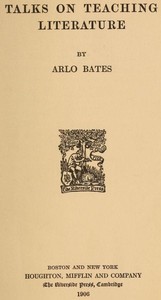
Talks on Teaching Literature — Themes and Context can be approached with a clearer sense of reading commitment from its source measurements: 65,845 words, 4 hr 47 min estimated reading time, and 25 detected text sections.
The text analysis averages about 26.8 words per sentence, while the detected sections provide another way to judge how the source is divided.
Project Gutenberg metadata also associates the work with “Literature -- Study and teaching,” connecting these edition facts with the source record’s subject description.
Explore this collection
These alternatives are selected using recorded categories and estimated reading time.
About 295 minutes
Historical Textbooks
67,708 recorded words. 8 minutes difference from this book's estimate.
View Gutenberg source #29068About 262 minutes
Historical Textbooks
60,050 recorded words. 25 minutes difference from this book's estimate.
View Gutenberg source #21781About 183 minutes
Historical Textbooks
41,944 recorded words. 104 minutes difference from this book's estimate.
View Gutenberg source #15353Search stored excerpts and compare books → Choose by your preferences →
Choices use stored catalog measurements. Estimates vary with reading speed. A shared category is a catalog label, not a claim that two books have the same argument or literary quality.
Search reads excerpt text stored with this catalog and links to its associated Gutenberg record. The connection is stored in the site database; this tool does not recheck that every excerpt is word-for-word identical to that external record. Excerpt search does not cover every chapter and does not verify historical publication dates.
Catalog snapshot checked: 2026-09-25. Coverage: 96 public books, 96 available source excerpts.
Calculated from edition completeness, EPUB availability, text structure and catalogue metadata. Not a user rating.
Total of 100 points, scaled to a 2.5-5.0 range. Editions with an empty description or a missing EPUB file are not scored.
Public-domain source text
The source text is kept in the dedicated reader, separate from this catalogue record and its commentary.
Arlo Bates opens his first talk by confronting a disquieting possibility: that literature cannot be taught. He grounds this doubt in the nature of art itself, arguing that a poem or novel conveys what no other form of words can express, leaving the teacher to talk about qualities rather than delivering the thing itself. This central tension—between the ineffable experience of art and the practical demands of a classroom—shapes the entire series. Bates does not offer a method so much as a persistent inquiry into what is possible when instruction meets the irreducible particularity of literary works.
Bates begins by naming the teacher’s blackest moments: the suspicion that literature cannot be taught at all. He insists that if a pupil learns anything in literature—as opposed to learning about it—the pupil does it alone. This is not a counsel of despair but a recognition that art exists because it says what cannot be said otherwise. A painting, a melody, a poem gives delight through qualities that belong to nothing else. Words cannot replicate those qualities, or the work itself would be superfluous. The teacher is therefore “apparently confronted” with an impossible task. Yet Bates does not stop there; he uses this paradox to frame the talks that follow, turning a theoretical dead end into a practical starting point.
In the chapter on examinational work, Bates describes a device he used at the Massachusetts Institute of Technology. Students were given a brief extract from a standard author they had never seen before—in one case, the opening lines of Paradise Lost, Book II—and asked to state its excellent points of workmanship, thought, and imagination. The purpose was to see how intelligently they could apply principles they had learned, not to test recall of assigned readings. Bates emphasizes that only merits were requested, to strengthen the habit of looking for excellencies. One student’s comment on the word “barbaric” in Milton’s line shows the kind of independent thinking the exercise aimed to elicit: the student connected the word to “early inhabitants of the uncivilized rich countries of the east” throwing wealth around like pebbles.
Bates warns against setting students to write “formal and lifeless themes on pedantic topics” that replace intelligent comprehension with mechanical imitation. Such exercises, he argues, are not the study of literature but a “stultifying process” that lessens the power of appreciation. He insists that the supreme test of any subject given for written work is whether it is reasonable to suppose students can and will have individual, original thought about it. The writing of themes belongs to the examinational side of the work and should not be dwelt on more than necessary. It must stay within the range of the student’s personal experience. This pragmatic caution runs through the talks, always returning to the goal of genuine engagement rather than rote performance.
The book’s structure mirrors its origin as a series of lectures delivered at the University of Illinois Summer School in June 1905. Each talk builds on the previous one, moving from the problem and conditions of teaching literature through specific difficulties, foundations, and methods. Bates devotes separate chapters to the study of prose, the novel, and Macbeth, using each as a concrete illustration of his principles. The movement is from general to particular, from doubt to practical suggestion. The final chapters on criticism, literary workmanship, biography, and voluntary reading broaden the scope again, ending with a chapter titled “In General.” This alternating rhythm of problem and example gives the talks a cumulative force, as if the reader is attending the summer school alongside the original audience.
Bates’s talks are best read as a series of provocations rather than a manual. He does not promise a system that will make literature teachable; instead, he offers a way of thinking about the classroom that keeps the art itself at the center. Readers who expect step-by-step instructions will be disappointed, but those who welcome a thoughtful, sometimes skeptical companion in their own teaching will find much to return to. The book rewards attention to its recurring images—the black moment, the stultifying theme, the unfamiliar extract—and to the quiet insistence that students must be allowed to think for themselves.
That old Bates book kept circling back to me—the way he insists a teacher must feel literature before explaining it. It reminded me of something quieter, a Spanish reader I stumbled upon later, where the stories simply breathe. A First Spanish Reader — Inside the Classic has that same unhurried warmth, letting the language unfold like a familiar tune. I think of them together sometimes, two gentle voices across the years.
Build a private reading journal entry for this title.