About 172 minutes
Reading Made Easy for Foreigners - Third Reader — Reading Notes
Historical Textbooks
39,359 recorded words. 5 minutes difference from this book's estimate.
View Gutenberg source #15747
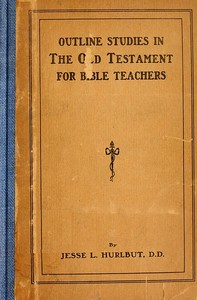
For Outline Studies in the Old Testament for Bible Teachers — Reading Companion, the stored edition analysis reports 40,545 words, 2 hr 57 min estimated reading time, and 6 detected text sections.
The text analysis averages about 15.8 words per sentence, while the detected sections provide another way to judge how the source is divided.
Project Gutenberg metadata also associates the work with “Bible. Old Testament -- Textbooks,” connecting these edition facts with the source record’s subject description.
Explore this collection
These alternatives are selected using recorded categories and estimated reading time.
About 172 minutes
Historical Textbooks
39,359 recorded words. 5 minutes difference from this book's estimate.
View Gutenberg source #15747About 183 minutes
Historical Textbooks
41,944 recorded words. 6 minutes difference from this book's estimate.
View Gutenberg source #15353About 98 minutes
Historical Textbooks
22,349 recorded words. 79 minutes difference from this book's estimate.
View Gutenberg source #14403Search stored excerpts and compare books → Choose by your preferences →
Choices use stored catalog measurements. Estimates vary with reading speed. A shared category is a catalog label, not a claim that two books have the same argument or literary quality.
Search reads excerpt text stored with this catalog and links to its associated Gutenberg record. The connection is stored in the site database; this tool does not recheck that every excerpt is word-for-word identical to that external record. Excerpt search does not cover every chapter and does not verify historical publication dates.
Catalog snapshot checked: 2026-09-25. Coverage: 96 public books, 96 available source excerpts.
Calculated from edition completeness, EPUB availability, text structure and catalogue metadata. Not a user rating.
Total of 100 points, scaled to a 2.5-5.0 range. Editions with an empty description or a missing EPUB file are not scored.
Public-domain source text
The source text is kept in the dedicated reader, separate from this catalogue record and its commentary.
Jesse L. Hurlbut's Outline Studies in the Old Testament for Bible Teachers (1905) was commissioned by the New York State Sunday School Association's Normal Committee as part of a two-year teacher-training course. The catalog subjects label it a 'textbook' on the 'Bible. Old Testament,' but the excerpts reveal a narrower focus: the history, geography, and institutions of ancient Israel, presented through a series of lesson outlines. Hurlbut explicitly states his purpose is not to furnish 'a series of new lessons' but to compile existing studies into one volume, incorporating 'recent knowledge, especially in the chronology.' The work is thus a pedagogical tool, not a comprehensive commentary.
The first study, 'The Old Testament World,' opens with the assertion that 'the Bible is primarily a book of history' and that understanding its lands is essential. Hurlbut defines the historical field as extending 'from the river Nile to the lands east of the Per´sian Gulf' and from the northern Red Sea to the southern Caspian, an area 'less than half the area of the United States.' This geographical framing is consistent throughout the excerpts; for example, in the study of Solomon's reign, he lists commerce with 'E´gypt, A-ra´bi-a, Tar´shish, and O´phir' as a source of wealth. The catalog subject 'Bible. Old Testament -- Textbooks' does not capture this emphasis on physical setting as a primary organizing principle.
Hurlbut's treatment of Solomon's reign exemplifies his institutional approach. He enumerates 'five general aspects of Is´ra-el' during that period: peace, strong government, wide empire, abundant wealth, and literary activity. Under wealth, he itemizes five sources: conquests, tribute, commerce, taxes, and public building. He then lists six 'dangers,' including absolute power, formal worship, luxury, taxation, heathen customs, and tribal jealousy. This structured, almost formulaic presentation—complete with a 'Blackboard Outline' and 'Questions for Review'—reflects the textbook's design for memorization and classroom recitation. The catalog subject does not convey this systematic, pedagogical method.
The excerpts include a 'Blackboard Outline' that condenses the lesson into abbreviated phrases (e.g., 'V. Gen. Asp. Isr. 1. Pea. 2. Str. gov. 3. Wi. emp. 4. Abun. weal.') and a set of review questions. This apparatus reveals the work's intended use: not for private study but for oral instruction by Sunday school teachers. Hurlbut also adds two new lessons—'The Old Testament as Literature' and 'How We Got Our Bible'—at the committee's request, indicating a responsiveness to contemporary educational trends. The catalog entry, however, lists only 'Bible. Old Testament -- Textbooks,' omitting the work's specific training purpose and its reliance on mnemonic devices.
Readers approaching this text should recognize it as a period piece of religious education, not a modern critical introduction. Its value lies in its snapshot of early 20th-century pedagogical methods and its systematic organization of then-current biblical scholarship. The blackboard outlines and review questions are best used as historical artifacts of how the Old Testament was taught in Sunday schools, rather than as study aids for contemporary readers.
I found myself returning to Hurlbut’s old teacher’s manual the other evening, struck by how quietly he trusted a simple blackboard outline to hold a whole story’s weight. That patient faith in structure reminded me of another, gentler voice who once argued that literature teaches best when we simply walk beside it, pointing softly. Talks on Teaching Literature — Themes and Context feels like that kind of companionship.
Your answers remain private and are stored only in this browser.