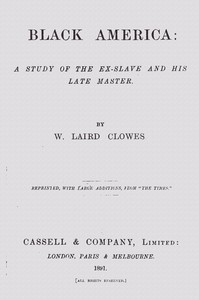
Black America : A study of the ex-slave and his late master by Sir W. Laird Clowes
Sir W. Laird Clowes wasn't your typical travel writer. He was a British expert on naval warfare who decided to take a long, hard look at the United States just a generation after the Civil War. His book, Black America, is the result of that journey. He didn't just visit cities; he went deep into the rural South, to places still scarred by the recent past.
The Story
There isn't a traditional plot. Instead, think of it as a series of snapshots and conversations. Clowes describes the landscapes, the ruined plantations, and the new Black towns springing up. He records long talks with white Southerners who are bitter and struggling, and with Black Americans who are building schools, buying land, and trying to carve out freedom with very little. He's obsessed with data—crop yields, literacy rates, crime statistics—trying to measure progress in a society that was fundamentally broken. The "story" is his attempt to diagnose whether America's experiment in multiracial democracy has any chance of success.
Why You Should Read It
You read this book for the perspective. It's jarring, enlightening, and often uncomfortable. Clowes is a product of his time—he has beliefs about race and civilization that will make you cringe. But that's the point. He's an outsider trying to make sense of America's original sin and its chaotic aftermath. His observations on the economic interdependence of former slaves and masters, the rise of Black political power, and the simmering white resentment are incredibly sharp. Reading him is like listening to a very smart, very biased friend from another country explain your own history back to you. It forces you to see familiar struggles through a completely different lens.
Final Verdict
This isn't a breezy read. It's for the curious reader who loves primary sources and isn't afraid of complexity. It's perfect for history buffs who want to move beyond textbook summaries of Reconstruction and feel the gritty reality of that era. If you've read works by Black authors from that period, like Booker T. Washington or W.E.B. Du Bois, reading Clowes gives you the other side of the conversation—the view from a privileged outsider trying, and often failing, to understand a revolution he's witnessing. It's a challenging, thought-provoking piece of the puzzle.