
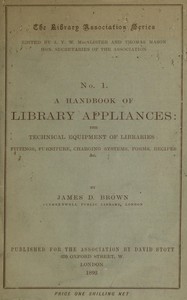
A handbook of library appliances by James Duff Brown
Let's clear something up right away: A Handbook of Library Appliances is not a novel. You won't find a sweeping plot or deep character arcs. Instead, think of it as a time capsule and a set of brilliant instructions. Published in 1892, it captures a specific moment in history. Public libraries were becoming widespread, and for the first time, massive amounts of information were becoming available to ordinary people. This created a huge, practical problem: chaos. How do you manage it all?
The Story
The 'story' here is the quest for order. James Duff Brown, a pioneering librarian, traveled around, looked at what worked (and what didn't), and compiled the best ideas into this book. He walks you through every physical piece of a library. We're talking about the design of the perfect bookstack to maximize space and light. He analyzes different styles of charging desks (the place where you check books out), arguing for efficiency. He details catalog cabinets, newspaper racks, step stools, and even library furniture. Each chapter is a deep dive into solving a real-world problem with wood, metal, and smart design. The conflict is simple: chaos versus system, and Brown is firmly on the side of system.
Why You Should Read It
This is where it gets cool. Reading this isn't about learning to build a shelf. It's about seeing the invisible architecture of knowledge. Every time you smoothly find a book using the Dewey Decimal system, you're benefiting from the kind of thinking Brown championed. His passion for creating spaces that are both functional and inviting for the public is genuinely moving. You start to see the library not just as a building with books, but as a carefully engineered machine for learning and discovery. The book is filled with detailed diagrams and photos, making it a surprisingly visual and tactile experience. It makes you appreciate the thought behind every piece of furniture you've ever taken for granted.
Final Verdict
This book is a niche gem, but a brilliant one. It's perfect for history buffs, design enthusiasts, librarians, and anyone fascinated by how systems shape our world. If you love books about the hidden logic of everyday things, or if you simply adore the quiet, orderly magic of a good library, you'll find this strangely captivating. It's not a casual beach read, but as a piece of historical insight into how we learned to organize our collective brain, it's absolutely fascinating.
Richard Hill
1 year agoIf you enjoy this genre, the storytelling feels authentic and emotionally grounded. Don't hesitate to start reading.









Jackson Clark
11 months agoI have to admit, it provides a comprehensive overview perfect for everyone. I learned so much from this.