
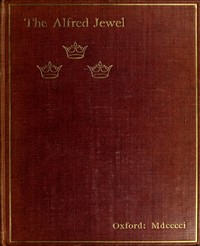
The Alfred Jewel: An Historical Essay by John Earle
First published in 1901, John Earle's The Alfred Jewel: An Historical Essay is a deep dive into one of England's most famous and enigmatic archaeological treasures. Earle, a respected scholar of his time, doesn't just describe the jewel; he prosecutes a case for its true purpose.
The Story
There isn't a plot in the traditional sense, but there is a central question: what was this thing for? The book walks us through the jewel's discovery in 1693 and its immediate recognition as an object of immense historical importance, linked to King Alfred the Great. Earle then systematically examines the evidence. He looks at the crystal covering the portrait, the intricate goldwork, and that powerful Old English inscription declaring Alfred as its commissioner. The big clue is the hollow socket at its base. Earle considers and dismisses popular theories of his day—that it was a pendant or a brooch. Instead, he builds a compelling argument that it was an aestel, a pointer used to follow lines of text in precious manuscripts. He connects it to Alfred's famous project to translate important books from Latin into English, suggesting these jewels were sent out with each copy as a royal gift and a tool for reading.
Why You Should Read It
What makes this book special is hearing a sharp, Victorian mind at work. You're not getting a modern, sterile analysis. You get Earle's passion and his sometimes firm, even dismissive, opinions on other theories. It feels personal. He's convinced he's right, and his enthusiasm is contagious. Reading it, you get a double history lesson: one about Alfred's 9th century, and one about how 19th-century scholars thought about the past. It’s a snapshot of historical reasoning itself. The prose is old-fashioned but clear, and the mystery at its heart is timeless.
Final Verdict
This is a perfect bite-sized read for anyone who loves a good historical puzzle. It's ideal for fans of Anglo-Saxon history, museum-goers who have stared at the Jewel and wondered about it, and readers who enjoy seeing how ideas are formed from physical evidence. It's not a general biography of Alfred; it's a focused, 100-page investigation. Think of it as the literary equivalent of a curator giving you a private, detailed tour of a single masterpiece, explaining not just what you see, but the centuries of thought behind it.
Robert Young
1 year agoSurprisingly enough, it manages to explain difficult concepts in plain English. Truly inspiring.
Patricia Nguyen
1 year agoHonestly, it provides a comprehensive overview perfect for everyone. Exceeded all my expectations.
Ethan Jones
1 month agoHigh quality edition, very readable.
Anthony Thompson
8 months agoI didn't expect much, but the character development leaves a lasting impact. Absolutely essential reading.
Michael Davis
1 year agoFive stars!